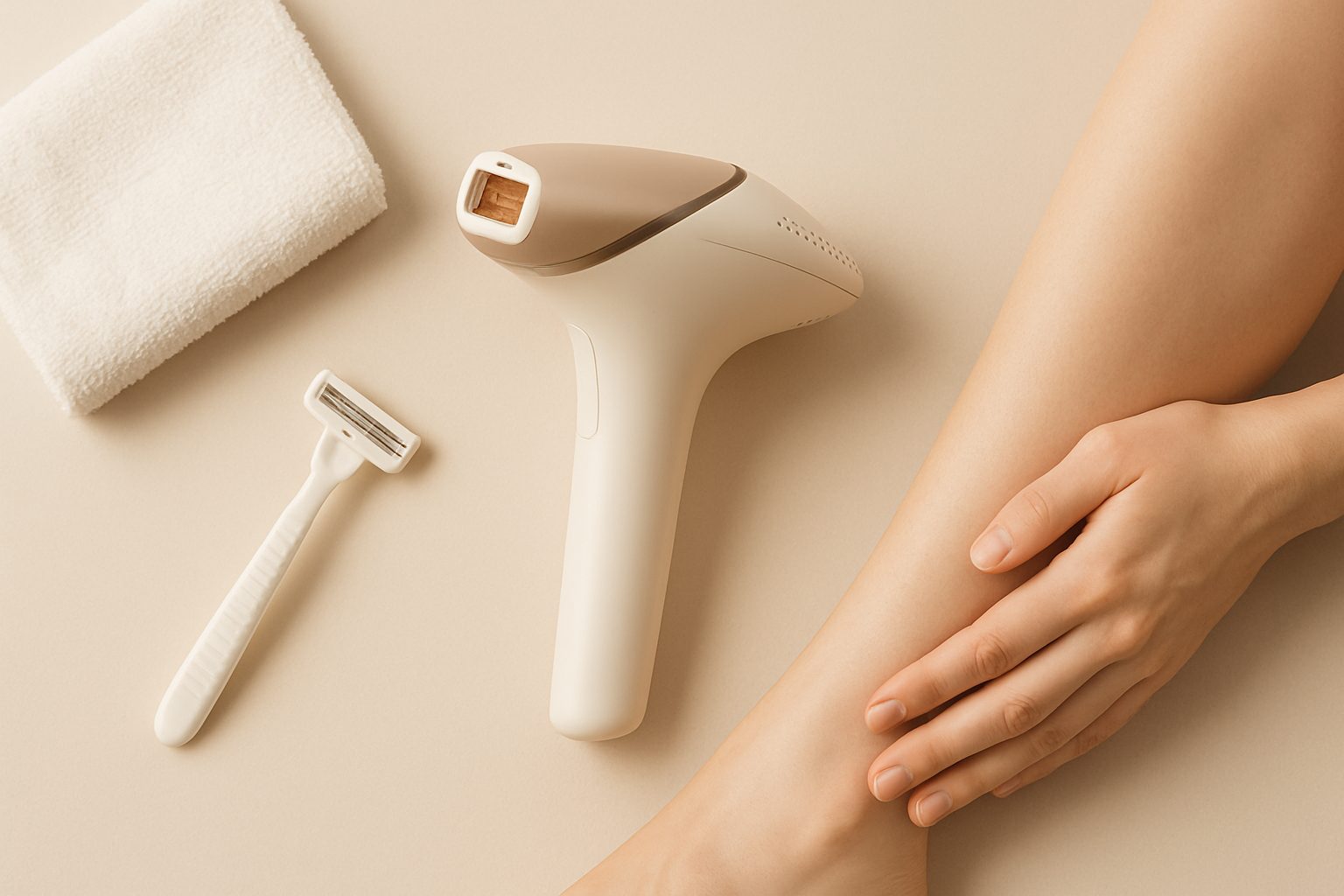
Philips Lumea Prestige Review UK 2025 – Our Full Long-Term Test
We've been testing the Philips Lumea Prestige for the best part of four months now, using it every 4–6 weeks on underarms, legs, and the bikini line. It's the flagship model in Philips's home IPL range, positioned firmly at the luxury end of the market, and the price reflects that—it costs almost twice as much as the Lumea Essential. After this much time with it, we've got a clear sense of what the extra money actually buys you.
What You Get in the Box
The Prestige ships with four attachments: the standard full-face cartridge, a smaller precise one for the underarms and bikini line, a body one, and a facial one. Each has its own sensor integration (more on that), and they're all proprietary Philips pieces—you can't mix and match with older models. The handpiece itself feels significantly heavier and more premium than the cheaper Lumea Essential; there's real heft to it, which initially felt awkward but now feels reassuring in your hand.
The charging dock is properly designed too. Unlike some IPL devices that require you to hunt for a cable, this magnetically seats and charges in about 90 minutes. The battery indicator is clear, and we've never had it fail mid-session in four months of regular use.
SmartSkin Sensor: The Real Differentiator
The Prestige's headline feature is the integrated SmartSkin sensor, which reads your skin tone before every flash and automatically adjusts the intensity. In practice, this means you're not manually dialling in a power level and hoping it's right; the device figures it out.
We have fairly pale skin, so we tested the manual setting first (around level 5 of 5). The SmartSkin sensor reliably locked onto intensity 4–5, which matched what we'd chosen manually. For the few sessions with our partner (much darker skin tone), the sensor adjusted to level 2–3 without any input from us. Neither setting caused visible irritation or burns.
It's not infallible—if you have tattoos, the sensor can get confused and reduce the intensity, which is a safety feature but means you do need to understand why it's doing it. And on stubble (if you haven't shaved beforehand), the sensor can overshoot and feel uncomfortably hot. But for most standard use cases, SmartSkin removes the guesswork.
Results: What Actually Happens
Honest talk: this is an IPL device, not a laser, so it's not as powerful as professional treatments. But it does work. After the first month, regrowth in treated areas genuinely tapered. By month three, we saw maybe 70–75% reduction in hair density on our legs and underarms. The bikini line was stickier—the hair there is coarser and darker, so it did respond, but slower. We're not hair-free, but we're maintaining this outcome with sessions every 6 weeks.
The Prestige is gentler than the cheaper models we've tried previously (the Essential and Lumea 7), which makes sense given the sensor-driven approach. Each flash feels controlled rather than aggressive. Sessions are reasonably quick too—a full-leg treatment takes about 25 minutes.
Prestige vs Lumea Essential
The Essential costs around £250; the Prestige is closer to £450. For that £200 difference, you're paying for:
- The SmartSkin sensor – removes manual intensity guessing
- Four attachments instead of one – dedicated facial and small-area cartridges are genuinely useful
- Better build quality – the Prestige feels like it'll last longer; the Essential feels more plasticky
- Facial use – the smaller facial attachment and sensor tuning make facial use easier, though you still need to be cautious around eyes and lips
The Essential does work, but you're adjusting intensity by hand, and there's only one cartridge size. For someone who wants to treat legs only and doesn't mind tinkering with settings, the Essential is decent value. If you're treating multiple body areas or have varying skin tones in your household, the Prestige's flexibility is worth it.
Downsides Worth Knowing
The Prestige isn't perfect. The replacement cartridges are expensive—around £25–30 per refill—and each one gives you roughly 1,500 flashes. That's only four or five full-body treatments. If you're treating large areas regularly, the cost per session starts to feel significant.
It's also noisy. Not unbearable, but a distinct mechanical whirr that catches you off guard the first few times. And it does get warm with extended use; the handpiece has a built-in cooling pause that kicks in automatically, which is a safety feature but does slow down treating large areas.
The SmartSkin sensor is clever, but it does require you to understand what it's doing. If your skin is very reactive or sensitive, auto-adjustment might not always feel right, and you can't always override it easily.
The Verdict
The Philips Lumea Prestige is the most polished home IPL device we've tested. It delivers genuine hair reduction, handles multiple body areas well, and the SmartSkin sensor makes it genuinely easier to use than manual competitors. It's not cheap, and yes, you can get hair reduction from cheaper models—but the Prestige handles nuance (different skin tones, different body areas) in a way that feels less fiddly.
If you're serious about home hair removal and plan to use it regularly long-term, it justifies the cost. If you want to try IPL on a budget and don't mind tinkering, the Essential is still a reasonable starting point. But for most people treating multiple areas, the Prestige is the smarter buy.
More options
- Philips Lumea IPL Hair Removal Series (Amazon UK)
- Braun Silk Expert Pro 5 IPL (Amazon UK)
- Ulike Sapphire Air3 IPL Device (Amazon UK)
- SmoothSkin Pure Fit IPL (Amazon UK)
- Remington iLight IPL Hair Removal (Amazon UK)